
Golgota
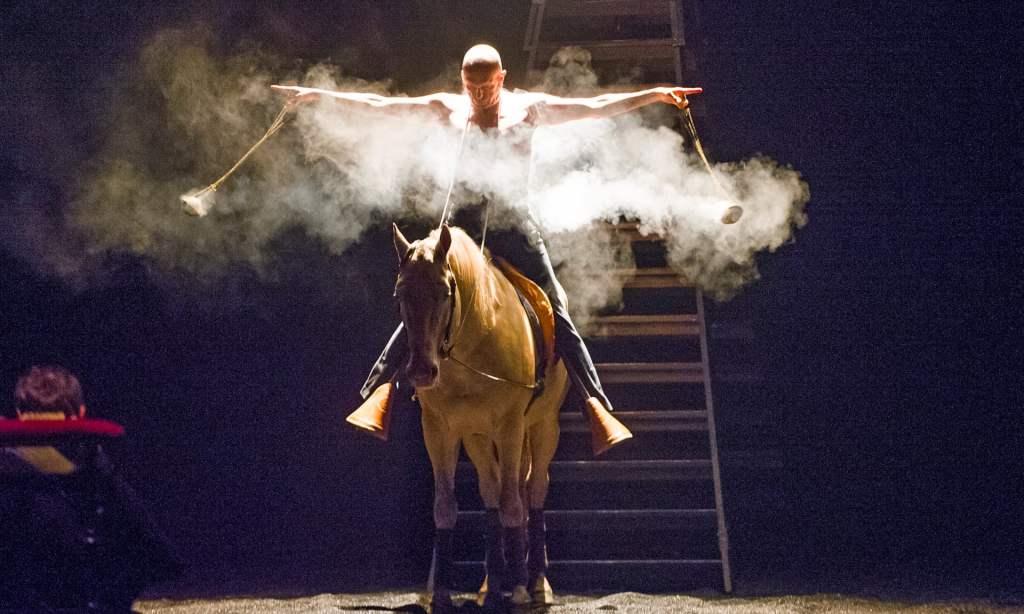
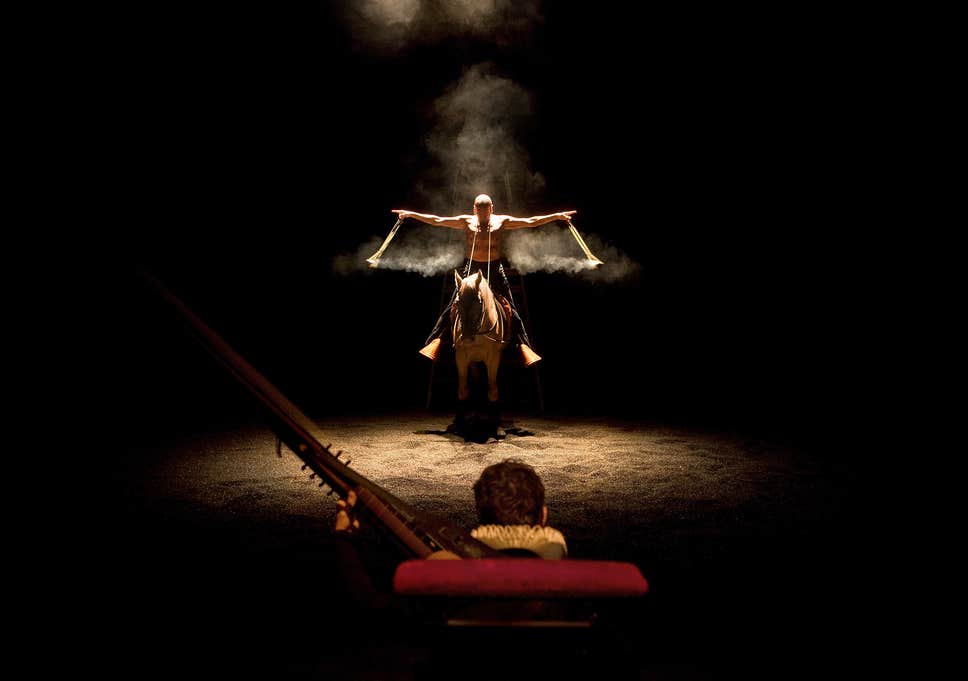
Golgota is a very male production (the Virgin Mary is notably absent), with Bartabas joined on stage by flamenco dancer Andrés Marín, three sombre white-ruffed musicians (straight from El Greco), a dwarf, four horses and a donkey.
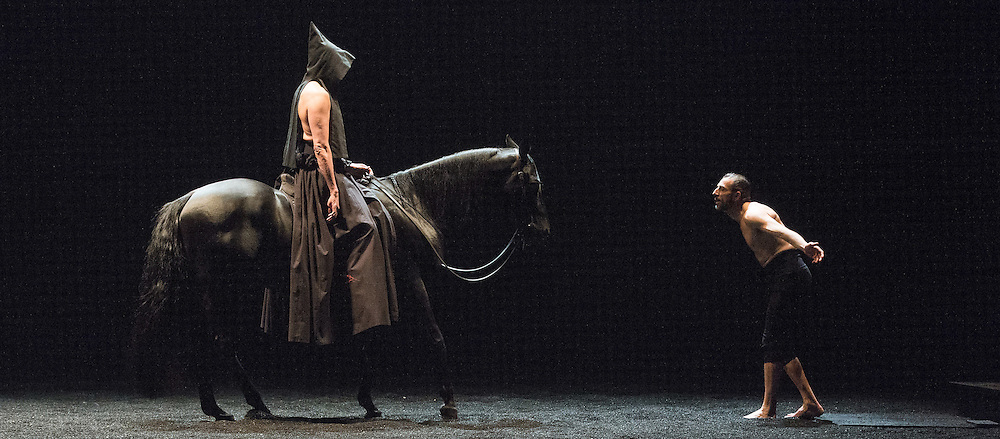
There’s no clear enactment of the Easter story, although the work is dense with images: priests, Roman soldiers, crucifixes, candles and incense, and comes with the piercing, live accompaniment of a selection of sacred motets by Tomás Luis de Victoria. As Bartabas has said, he and Marín are like boys “locked in a church”, who play with the materials around them.
Bartabas himself is a shamanistic presence, often robed or veiled, and his command of his animals has a magical intensity as he moves them through graceful circles, an elegant rising trot, or falls with them to the floor, in a slow-motion pietá. The stage is shadowy, and apart from the music the only sustained noise is made by Marín – dancing a brief zapateado solo, drumming with his hands, or performing the final extraordinary crucifixion scene, in which his feet (clad in hooves) violently stamp out Christ’s final agony. The work is hot, strange and compelling, but the finest moments are those where Marín dances with Bartabas and his horses, where he mimics their footwork and communicates with them through a language of nuzzles, glances and breaths. It’s surely in this ancient, wordless connection between man and beast that Golgota finds its true religion.

Who is Bartabas?
Famous for his use of horses as a means of artistic expression, Bartabas is a world-renowned rider, director and stage designer. His company, Zingaro Equestrian Theatre has performed all over the world for over 25 years but these special performances mark Bartabas’ first appearance in London.
Loungta
In 2003, le Théâtre équestre Zingaro presented Loungta – Les Chevaux de Vent at the Festival d’Avignon.
For twenty years, Bartabas, who leads the Théâtre Equestre Zingaro (Equestrian Theatre), has roamed around the world seeking inspiration in music, pursuing his essential quest for the pure gesture wherein human beings and animals reconcile spirit and body as the profane and the sacred in utmost simplicity.
Bartabas prefers ritual to spectacle. Each new musical encounter is a source of movement for this master. Algerian Berber music for the Opéra Equestre, the sonority of Rajasthan for Chimère, South Korean chants for Éclipse, contemporary partitions for Triptyk…
In August 2002, Bartabas returned to the East and spent a few days in a Tantric monastery in Gyuto, located in a former Tibetan province in the far north-east of India. There he watched as disciples sought their individual accomplishment on Buddha’s path, and was inspired by their rhythm, discipline and rigour which then helped him produce the images and the choreography for his new performance, Loungta, The Horses of the Wind.

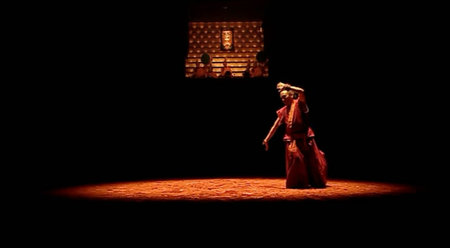
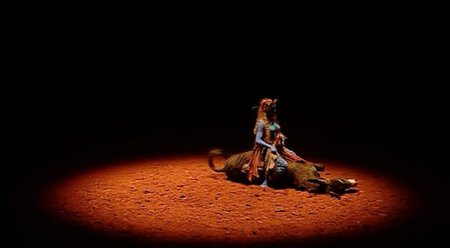
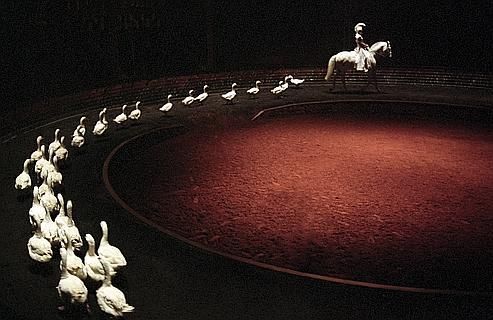
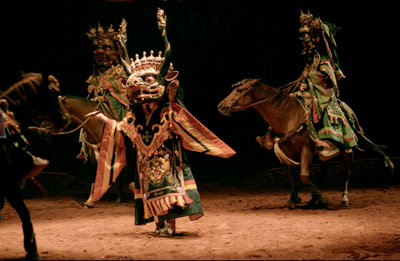
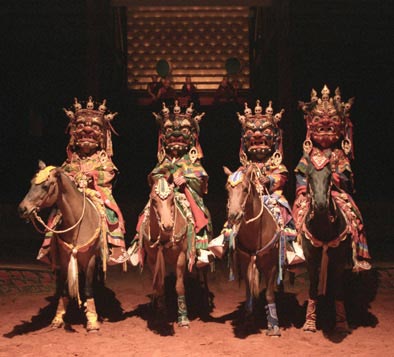
The riders, dancers and musicians are reunited in the ring. Ten Tibetan monks aged between twenty to seventy, diffuse the deep tone of their “buffalo voices”. On their traditional instruments, they play partitions which are indissociable from their daily religious practices.
They agreed to leave their monastery to share three years of the daily life of the company. About thirty horses, twenty riders and dancers are clad in costumes inspired by certain ancestral rituals and their faces are the angry masks of the gods and goddesses of death. Bartabas returned from the jungle and the areas around the Himalayas with the desire to bring about a certain state of being among his horses and his riders, to attain the precision/aptness of an increasingly elementary beauty.
Bartabas, while moving even further from the frivolity and frenzy of the contemporary West, re-asserts his philosophy, exalting ancient oriental values. He goes in search of the essence of beings, human or equine in a bid to bring them closer together and to celebrate them.
CIRCa Fesival
Initiated by members of the Jeune Chambre Economique (Economic Chamber of young business people), the CIRCA Festival was created in 1988.
In 2015, CIRCa created buzz by hosting the last Zingaro show as well as the well known Cirque Plume which then celebrated then its 30th anniversary. Since 2015, every year, the CIRC receives an average of 100 artistic teams, either artists in residence or shows programmed during the Season or during the Festival of Contemporary Circus.

 Time out of Time: