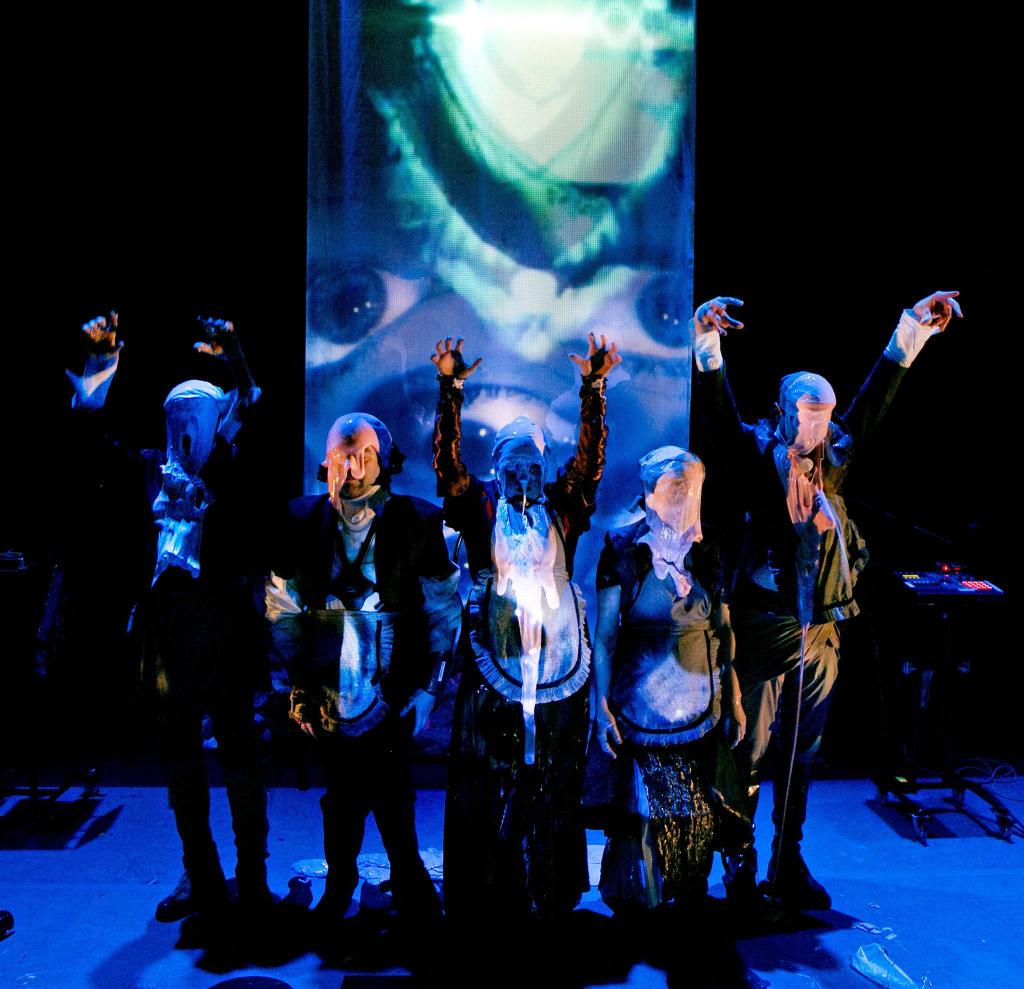
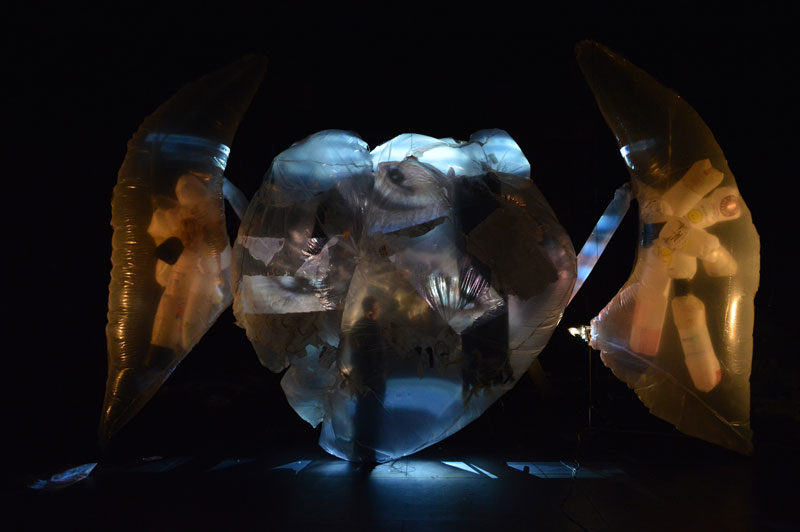
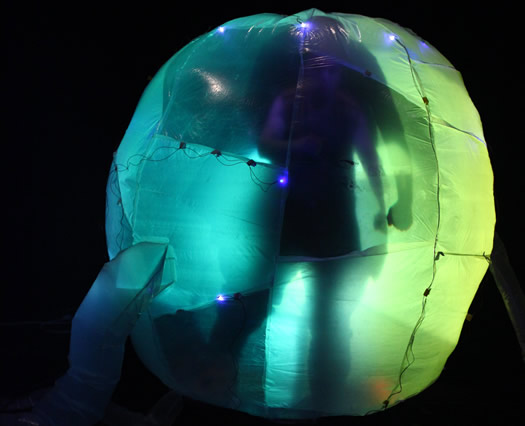
Influenced by James Whale’s Frankenstein films, Radiohole explodes the tumultuous and tragic life of Mary Shelley. Blood chilling and completely strange, Inflatable Frankenstein is brimming with whims, technological absurdity, and bodily fluids. A larger-than-life, Radiohole gothic teen sex dream. With Maggie Hoffman, Eric Dyer, Erin Douglass, Joseph Silovsky, and Mark Jaynes. Also introducing The Creature Without Organs.
Radiohole was birthed in a Brooklyn basement in 1998 by Erin Douglass, Eric Dyer, Maggie Hoffman and Scott Halverson Gillette. The company has produced ten original shows that have been presented at venues around New York City including PS122, the Kitchen and the Collapsable Hole (sic) and have toured nationally and internationally. Radiohole’s most recent show, “Whatever, Heaven Allows” was commissioned by PS122, The Walker Art Center and the Andy Warhol Museum through the Spaulding Gray Award. “Whatever, heaven Allows” had it’s European premiere in April 2012 at Katapult Teater at Godsbanen in Århus, Denmark. Over the years, Radiohole has earned a reputation as one of New York’s most tenacious and uncompromising ensembles.
The Curtis R. Priem Experimental Media and Performing Arts Center (EMPAC) is a multi-venue arts center at Rensselaer Polytechnic Institute in Troy, New York, which opened on October 3, 2008.
The founding director of EMPAC is Johannes Goebel. He was previously the director and founder of the Institute for Music and Acoustics at the Center for Art and Media Technology (ZKM) in Karlsruhe, Germany.
Curatorial Program
EMPAC’s curatorial program is dedicated to the commissioning, production, and presentation of ambitious performances and time-based artworks that foster meaningful engagement among artists, artworks, and our audiences. Over the past 10 years, EMPAC’s curatorial program has brought hundreds of artists to Rensselaer to create and perform new works across three areas of expertise: music, theater and dance, and time-based visual art.
EMPAC is committed to the in-depth support of artists over extended periods of time to realize complex projects that require not only EMPAC’s acoustic, spatial, and visual technological infrastructure, but also the interdisciplinary expertise of its curatorial, production, and administrative staff.
EMPAC’s artists-in-residence generate the diverse range of events which open the studio doors for campus and the general public. The curated program provides visitors with a breadth of experiences from theatrical productions, concerts, audio and video installations to a rigorous interdisciplinary program of films, talks, and workshops.
Many artworks produced at the center are made in collaboration with peer institutions, presenters, and museums, expanding the audience for an artist or artwork beyond Rensselaer and the Capital Region, centering Rensselaer within the international discourse around time-based arts and technology.
Residencies
Curated Residencies
Artist residencies are the heart of the curatorial program at EMPAC. Much of the work that we present is first developed in residency. In some cases, residencies serve as preliminary work for co-commissioned performances that find their premiere elsewhere. In both cases, curated EMPAC residencies figure into the overarching programming vision of the attending curator and often provide space, resources, and expertise unavailable elsewhere.
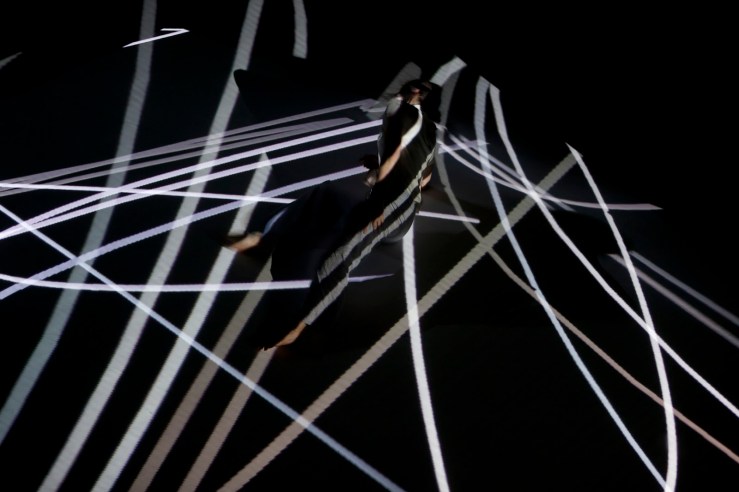
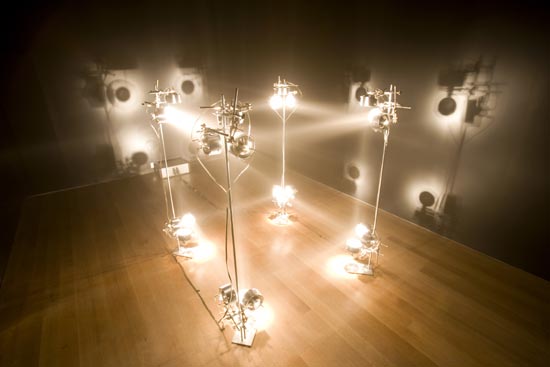
Example: Commissioned and partially developed through the EMPAC artist-in-residency program, Extra Shapes is a performance for lunging figures, a musical concert for loudspeakers, and a light show.
EMPAC—The Curtis R. Priem Experimental Media and Performing Arts Center at Rensselaer Polytechnic Institute is where the arts, sciences, and technology meet under one roof and breathe the same air. Four exceptional venues enable audiences, artists, and researchers to inquire, experiment, develop, and experience the ever-changing relationship between our senses, technology, and the worlds we create around us.
he 220,000-square foot building includes many firsts in the fields of acoustics, performing arts infrastructure, and architectural engineering. The integration of these features with audio, video, lighting, computer, and stage rigging networks makes EMPAC an ideal environment for human interaction with digital media.
Both a performing arts center and research and production facility, EMPAC provides an environment that supports the realization of complex artworks and research projects at any stage, from inception to completion.
The center has three curators focused on the areas of time-based visual art, theater, dance, and music. Within an interdisciplinary framework, each EMPAC curator is responsible for supporting the development and production of new works that stretch the boundaries of their field, interface with a diverse roster of international artists, and program challenging, adventurous performances for the Rensselaer campus and Capital Region communities. The team is led by founding director Johannes Goebel, who continues to be involved worldwide in the intellectual exchange on art, science, and technology, pursuing the questions of political, cultural, educational, and aesthetic relevance of the field.
Angela Stoecklin grew up in Iran and Nepal, and has been living in Switzerland since 1979. Practices in music and visual arts led her to dance. She was at Arts school Basel, got her dance education at ch- tanztheater Zurich, and holds a Master of Arts BFH in Contemporary Arts Practise. Angela worked and still works as dancer with numerous contemporary companies and productions in Switzerland, Germany and Belgium.
Creating her own projects, that lie more and more also in the interdisciplinary field, she closes the cycle of her artistic background. Fixed choreography which dismantels a specific form as necessity in the due of a process, as well as the momentary re/acting Instant Composition as direct interaction and absolute presence in the now are parts of her interests and means of working. She explores the multilayered facettes of communication and perception and explores process-oriented approaches. She has created choreography, performative and installation pieces, short to evening long productions, solo and interdisciplinary projects, and does intercultural work.
In 2019 she launched the first Festival Instant Composition for dance, artistics and music in Zurich. She is dance and movement pedagogue, acupressure therapist and Taijiquan and Qi Gong instructor.
“ghosts”, (Spazio Ludens2)
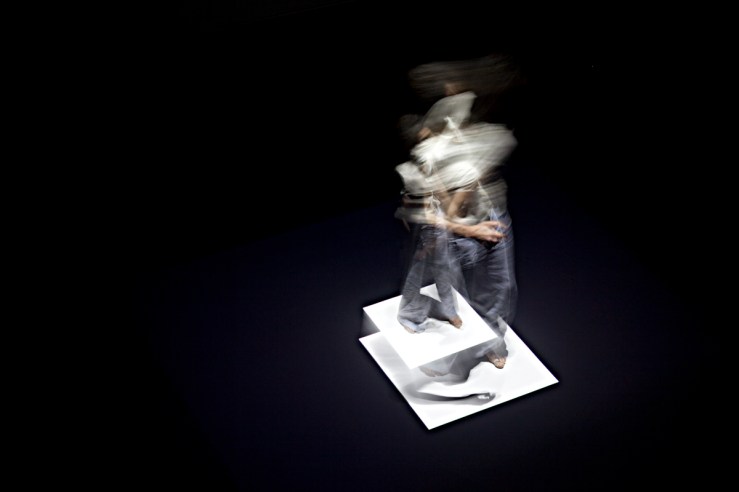
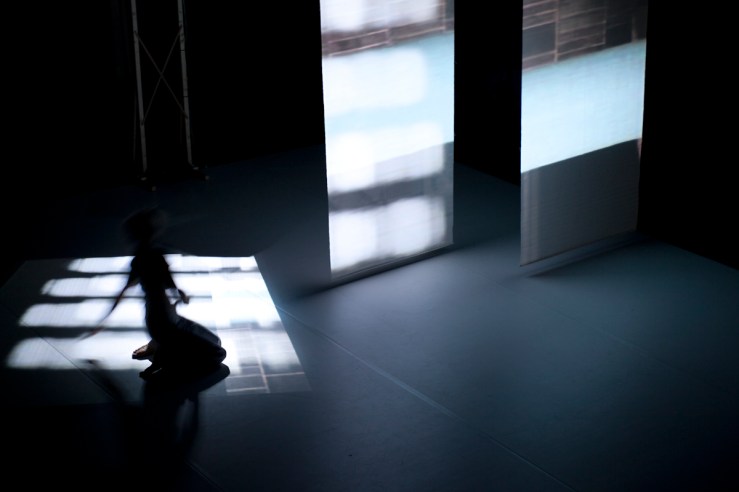
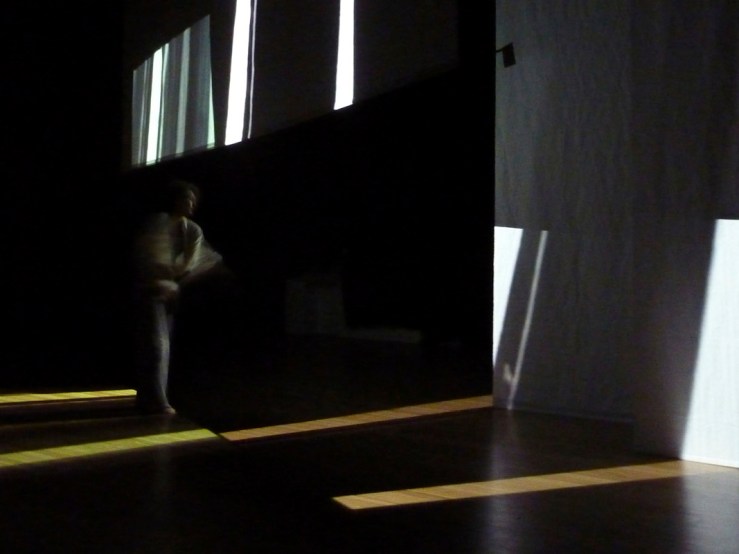
In „ghosts“, (Spazio Ludens2) a dacer, a musician, a visual spacial artist and a light designer interact in different spaces. Inspired by each specific situation they playfully transform them in installative performances. You find yourself in the midst of dream and nightmare, dense athmospheric imagry and silent shadows rushing by. Well tuned compositions meet the chaotic, childlike scenes with eerie ones.
Angela Stöcklin (concept, movement)
Matthias Rüegg (spacial design)
Anselm Caminada (Sound)
Antje Brückner (lighting design)
trans-form
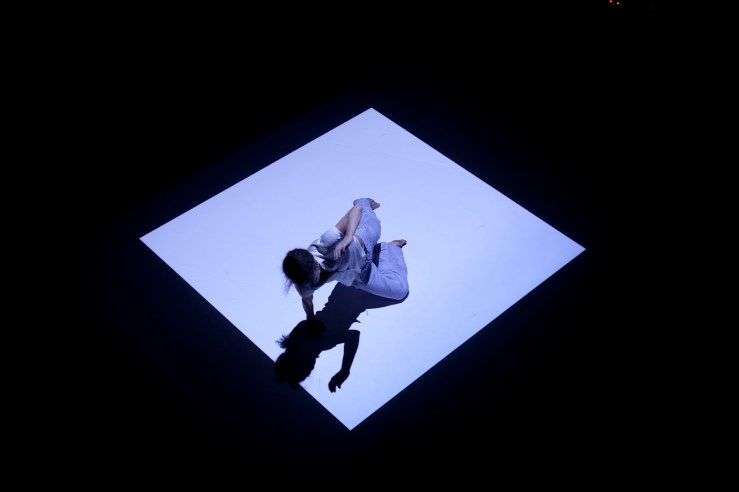
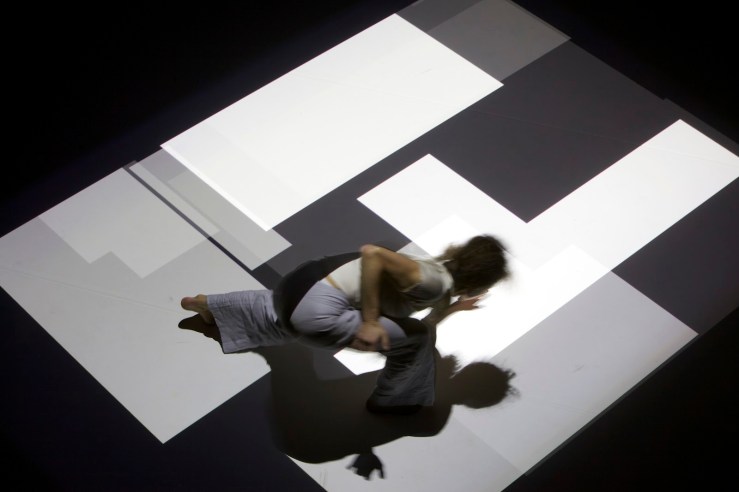
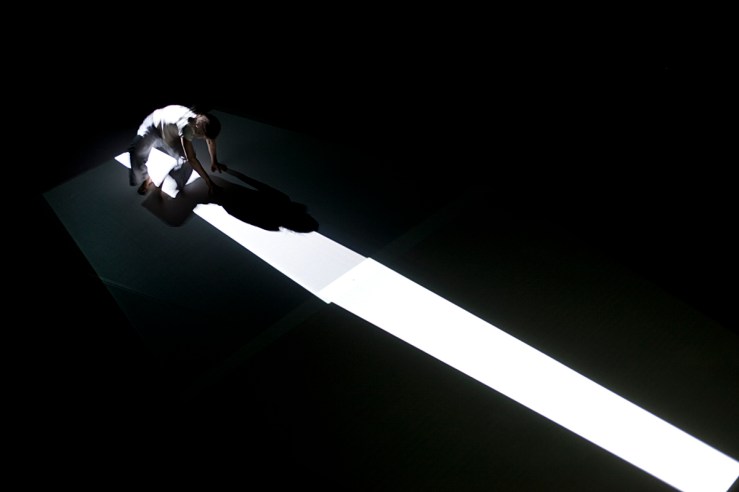
on a white open field and a space continuously being structured by screens movement (Angela Stoecklin, music (Marie-Cécile Reber) and light and images (Jan Schacher) play and become entwined. They interact in multiple layers of tension between freedom and dependance, structure and limitation, and try themselves with the imposibility of communication. Reciprocal restrictions lead to breaking out and flight, mutual impulses to an approach, which allows flickering moments of synchronicity. Engagement densifies and transforms, and unnoticably perception shifts. The interdisciplinary performance „trans-form“ deals with in/dependency and control in relationships and encounters.
installative performance: In a circle, surrounded by more or less reflecting panels a game of view-point, eye-catching and relating increases towards a tumultuous chase between performer, light and sound.
SPACEnr1 floating
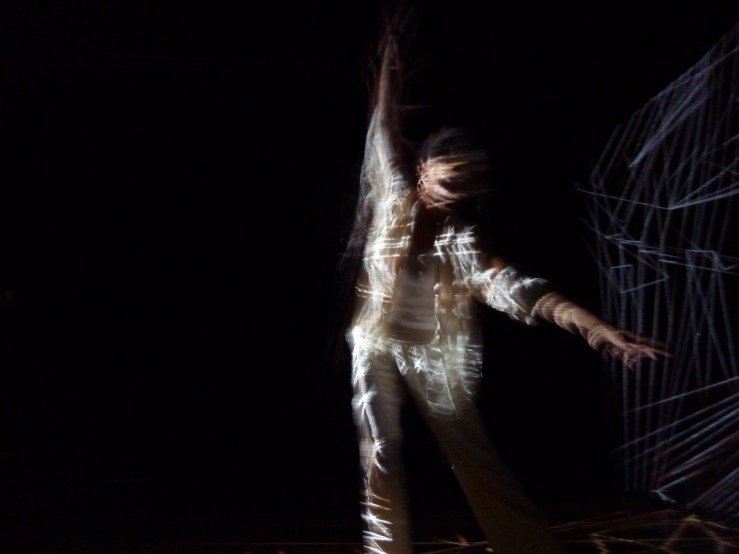
Light-apparitions dancing restlessly over walls and ceiling, plunging the space into darkness and light. A figure as secret tamer directs this play. Drawn out sounds put densifying atmospheres. Reflections, overlapping shadows, suddenly the face recognised in a mirror. Movement triples, eye is irritated as orientation gets disrupted and shifts. There is no story told, but many insinuated.
Name: “Time out of Time: a special place” Scene/Sequence Sheet
Date: 7/20/2019
Artist: Sound Artist François Donato, Visual artist Golnaz Behrouznia, Dance Artist Abd Al Hadi Abunahleh, Dance Artist Anas Nahleh, Visual Artist Ren
Scene 1: Opening 00:00 – 05:00
Scene 1 Notes:
1. François: Where are the audience? Play the video without sound.
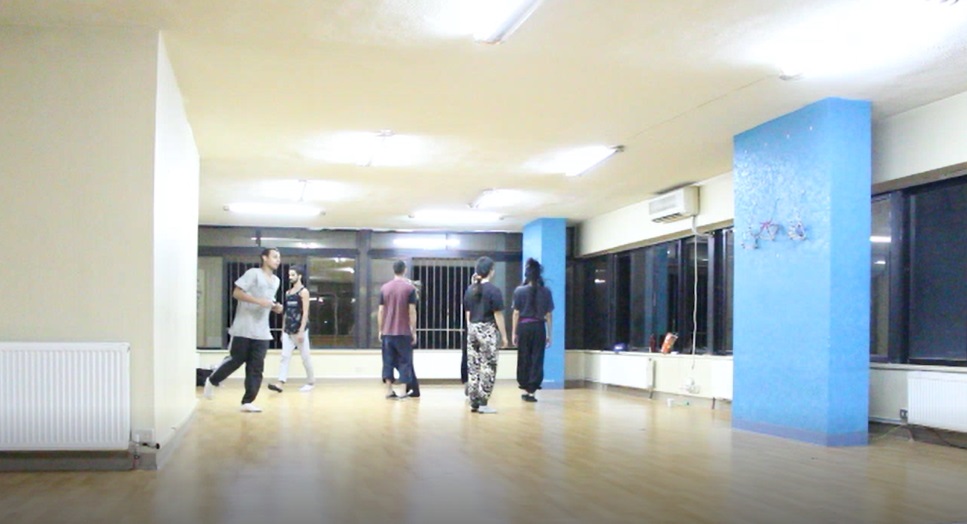
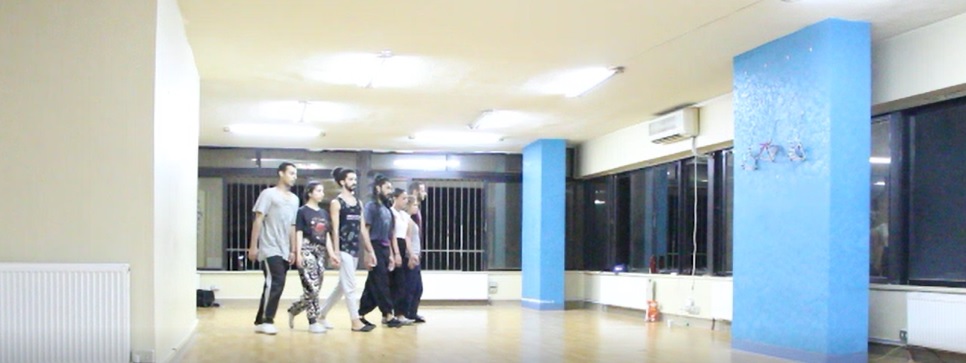
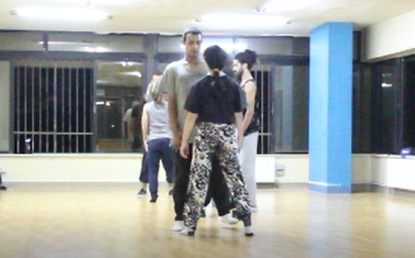
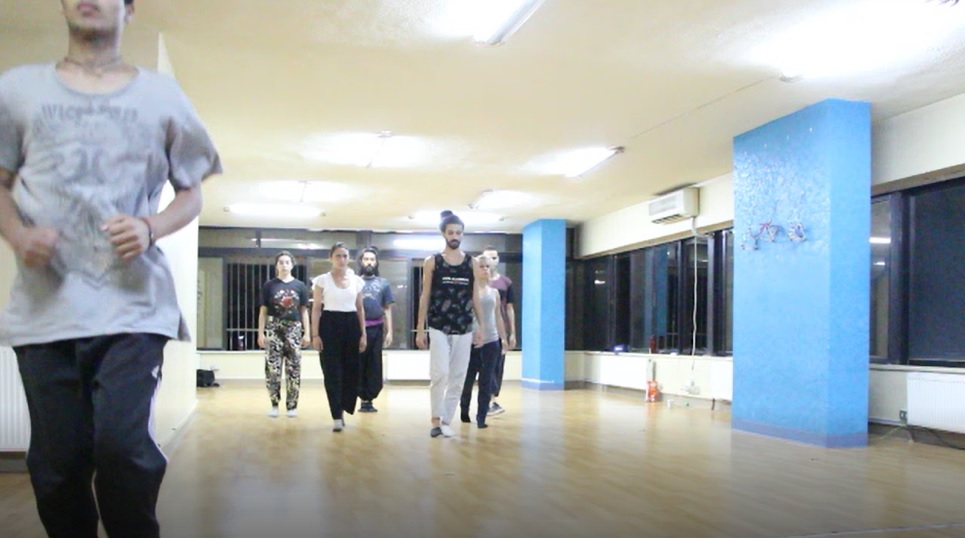
2. Abd: breakdown of the scene: Slow-motion walking -> run -> stop -> normal walking
3. François & Golnaz: What is Anas dance quality? Is there a contract between Anas and the rest of the group?
4. Abd: This is the introduction. Keywords: system, group, pattern VS individualism Anas is the exceptions. The group will eventually join Anas. There are different dimensions and subjects of liminal experiences, such as Individual, group, society experiences. Rite of passage: is a ceremony or ritual of the passage which occurs when an individual leaves one group to enter another. Rites of passage have three phases: separation, liminality, and incorporation.
Scene 2: Forming Circle 05:00 – 07:00
Scene 2 Notes:
1. Abd: Anas is the transformation agent. He initiated change. This is the beginning of a ceremony.
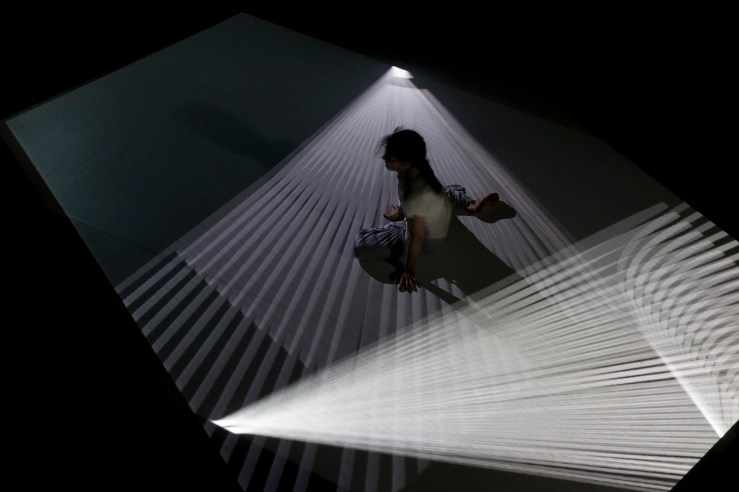
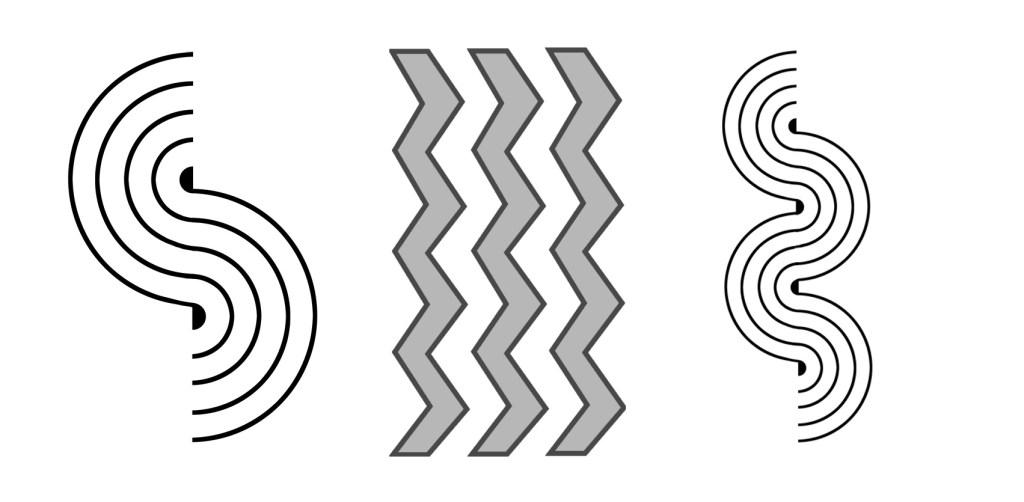
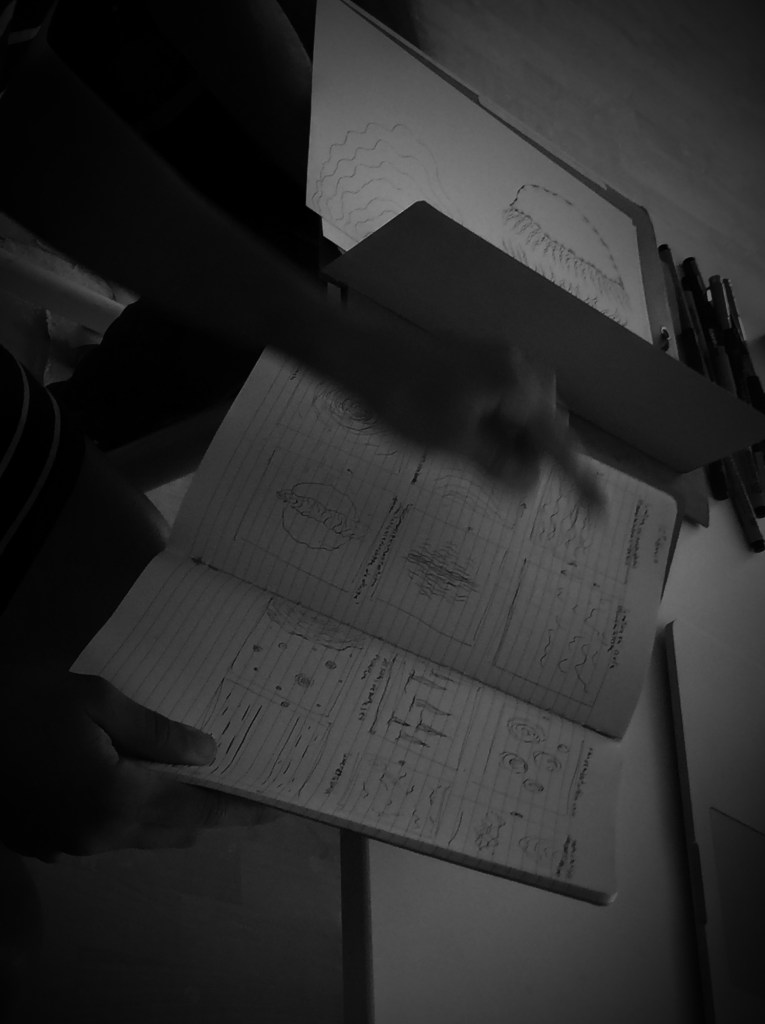
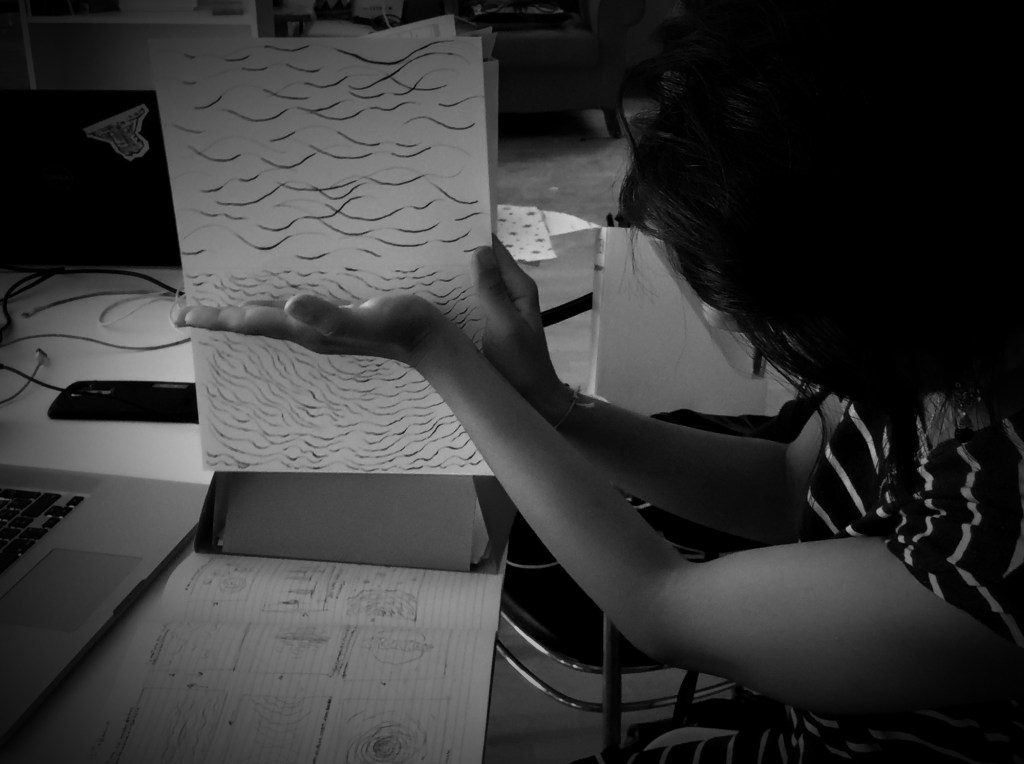
2. Golnaz: I had the idea of lines and swirls.
3. François & Golnaz: If Golnaz could come on August for the performance, we could synchronize the projected videos and switch of center of the dance choreography very well. Golnaz can play live.
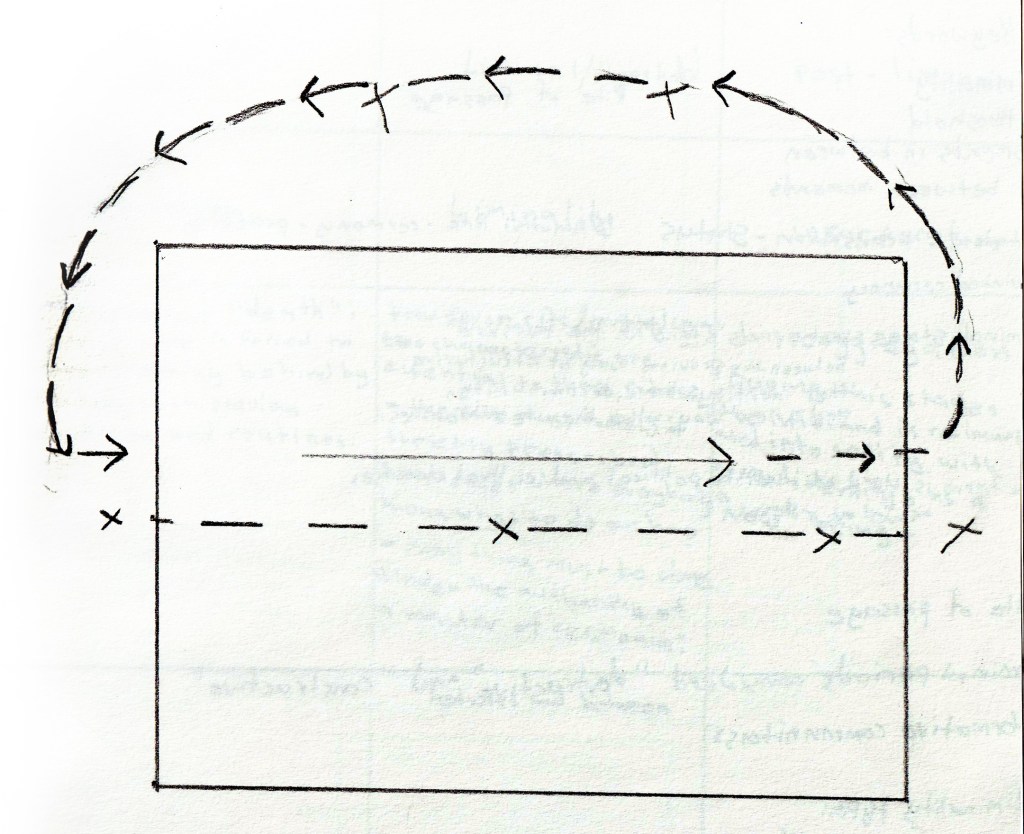
4. Abd: There are 3 centers. One is Anas at the one side, one is Ziad in the middle, one is Emram at the other side. We switch centers from Anas to Emram, from Emram to Ziad, ect.
5. François: Two things change. Center changes. Tempo changes.
6. Golnaz: I drew something new. It is geometric.
Scene 3: The Universe 07:00 – 08:00
Scene 3 Notes:
1. François & Golnaz: Is the speed the same? Does the speed increase?
2. Abd: breakdown of the scene: forming a circle->the universe->forming a circle
3. François & Golnaz: Circle is a system. It could evolve. We can try to push the limit of the system to provoke change. If the system is exhausted, change will occur.
4. Golnaz: We can try to move as slow as possible, really push the limit.
Scene 4: Zig-zag 08:00 – 09:00
Scene 4 Notes:
1. Abd: I intend to create a system, to create order and chaos.
2. François & Golnaz: It is interesting to play physics.
3. Abd: We can define the scene and show the difficulties of the movement and formations. We could give enough efforts of each experiments and tests.
Scene 5: Compass 09:00 – 10:00
Scene 5 Notes:
1. François: Why do they move only their legs instead of their arms?
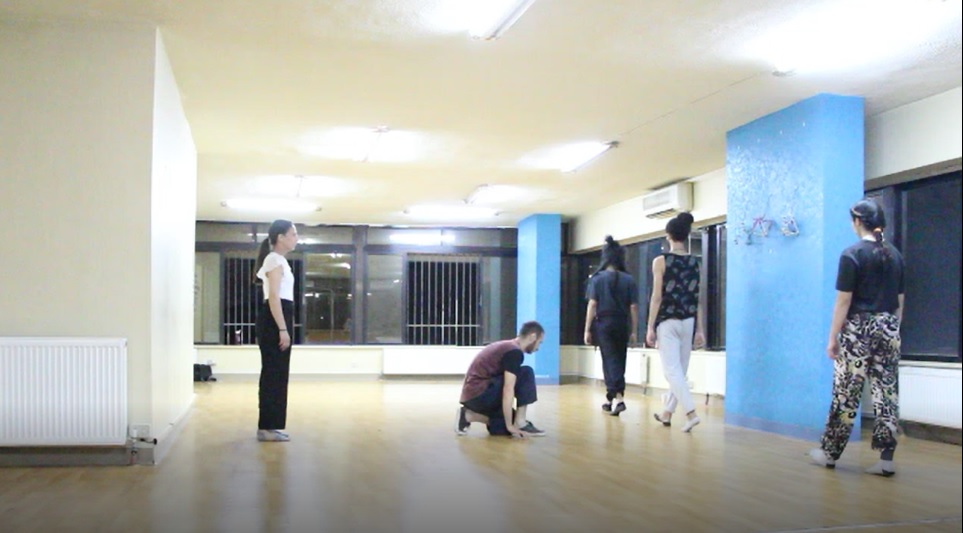
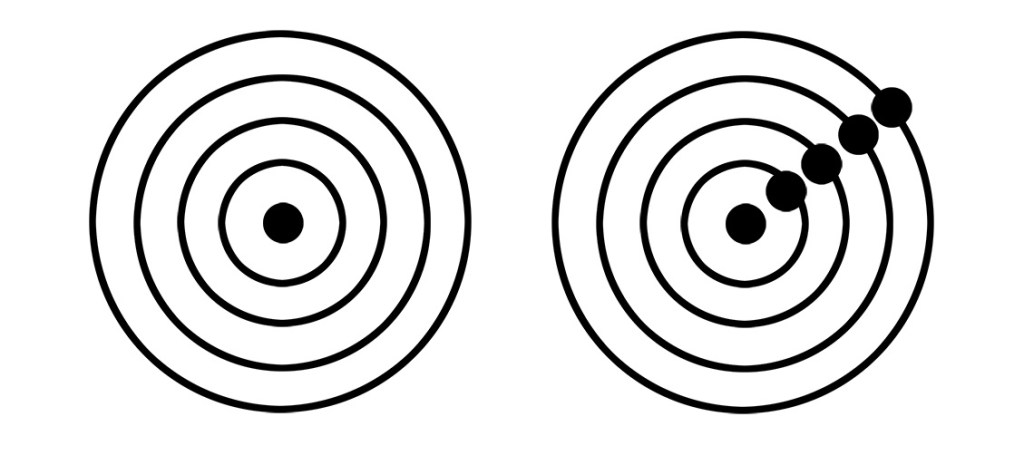
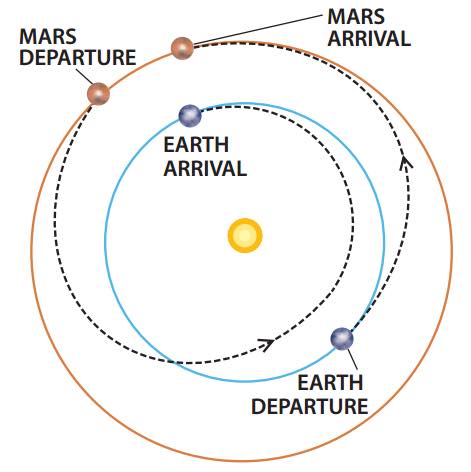
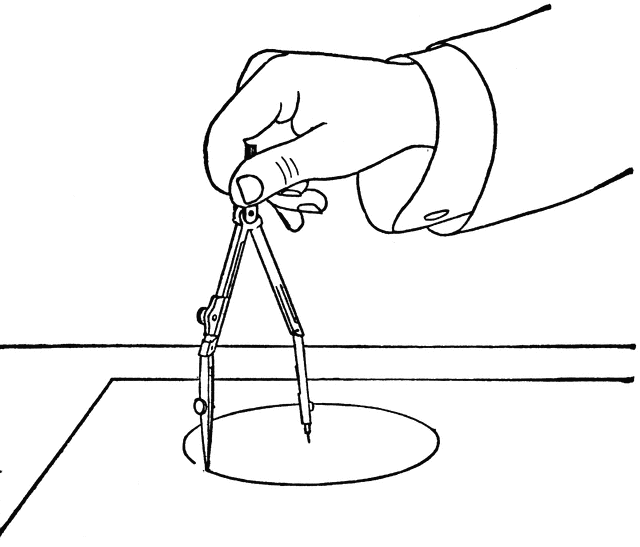
2. Abd: Collectively, seven dancers as group is a drawing tool. Individually, each dancer is also a drawing tool. This scene is inspired by the technical drawing instrument: compass. I am intended to create infinite loops or infinite circles.
3. François & Golnaz: A pair of compass has two legs, the straight or the steady leg and the adjustable one. It is interesting to see dancers balance between the steady leg and the adjustable leg. We could consider playing with the idea of losing balance or struggle to keep balance.
4. Abd: This is scene is also inspired the spinning coins. Seven dancers also collectively spring back and forth.
5. Golnaz: I think of the bouncing spring effect.
Spinning quarter on white.
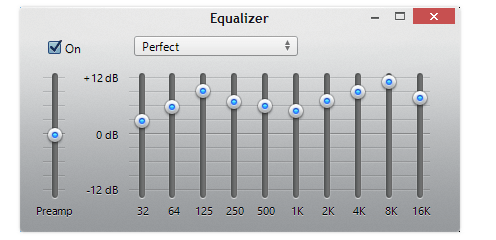
Scene 6: Equalizer 10:00 – 12:00
Scene 6 Notes:
1. Abd: This scene has a sense of separation.
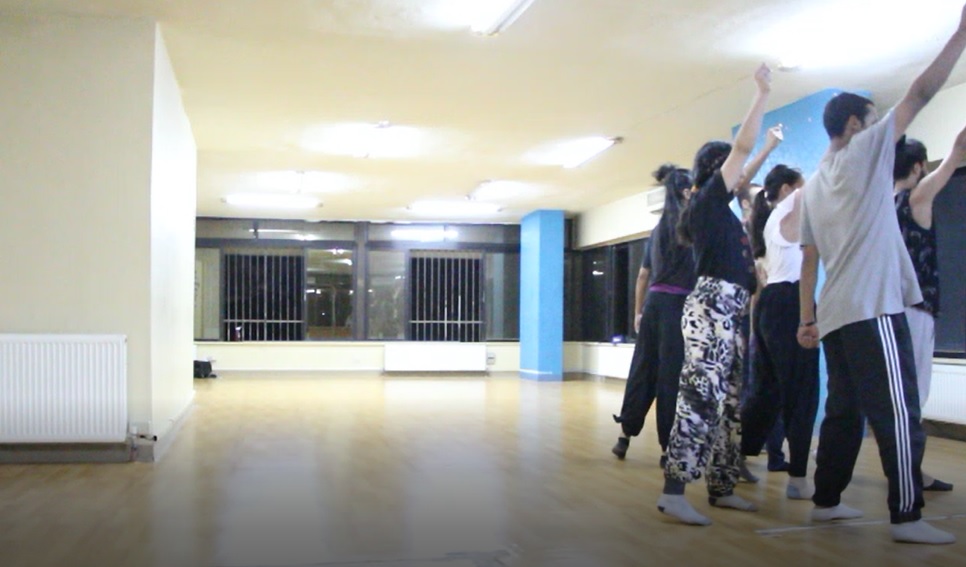
2. Ren: Are dancers facing the audiences or facing the side of the stage?
3. Abd: Side of the stage. After this scene, dancers form the universe again. (30 seconds)
Scene 7: End of the Ceremony 13:00 – 14:00
Scene 7 Notes:
1. Bashar: There is a scene which is not recorded. Dancers are weaving to each other.
Scene 8: Break the Trance 14:00 – 15:00
Scene 8 Notes:
1. François & Golnaz: Is this the moment braking the mechanism? We suggest to have no sound but the snap. There is another moment we can have no sound but the stage live sound. That is the moment dancers step. The stepping sound is interesting. 2. Abd: It is a moment audience come back to reality. The previous scenes may induce audiences into a trance. When I was watching, I tried to count. But for many times, I lost count. Sometimes I had a hypnotic experience. When dancers move forward and backward, I image them getting stuck in time.
3. Abd: There is sequence that dancers form a group; some lay on the floor.
4. François & Golnaz: For this sequence, we expect an acceleration. There are moments look like a quick version of previous movements in a sequence. To the audience, this might be repetitive.
Scene 9: Two Groups 15:00 – 18:00
Scene 9 Notes:
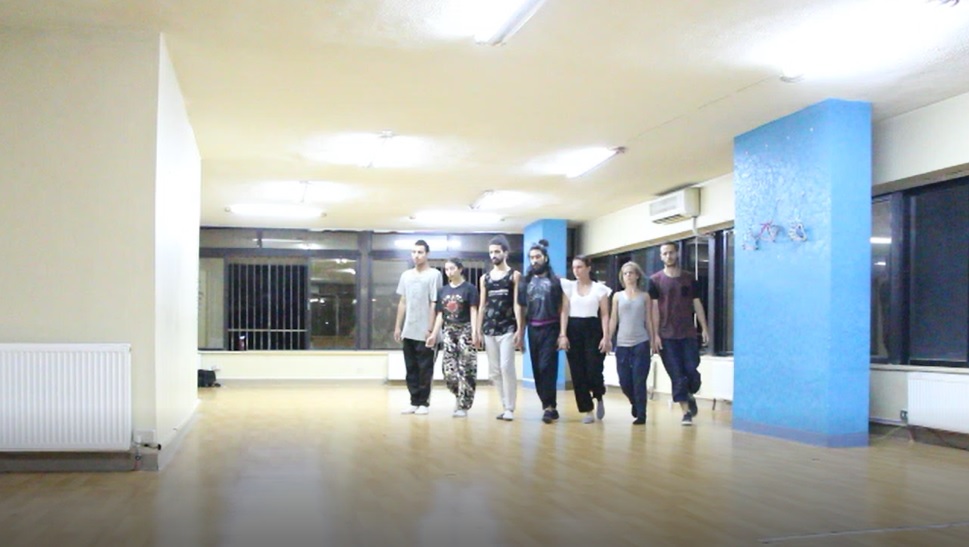
1. Abd: Seven dancers are divided into two groups of four and three. Four dancers are form a plus sign. Three dancers form another pattern. Seven dancers eventually join together. The division also echoes with the concept of the separation.
2. François & Golnaz: It is interesting to have two groups doing different things at the same time. But for a while, it is hard to know where to focus. We can actually guide the audience to focus on one group, then shift to another, then back to the one before by varies ways.
3. François: I see a pendulum effect.
4. Abd: The two groups actually influence each other.
Artist: Sound Artist François Donato, Visual artist Golnaz Behrouznia, Dance Artist Abd Al Hadi Abunahleh, Dance Artist Anas Nahleh, Visual Artist Ren, Dance Artist Emran Alamareen, Dance Artist Daniel Issa, Dance Artist Nadeen Dabass, Dance Artist Kate Port, Dance Artist Ziad Hajir, Dance Artist Oliveira Jara
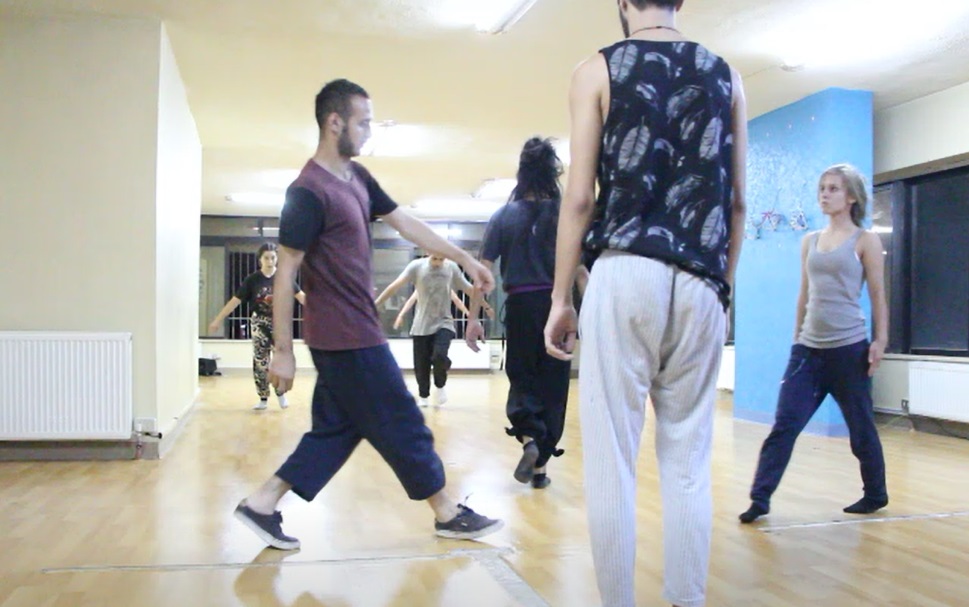
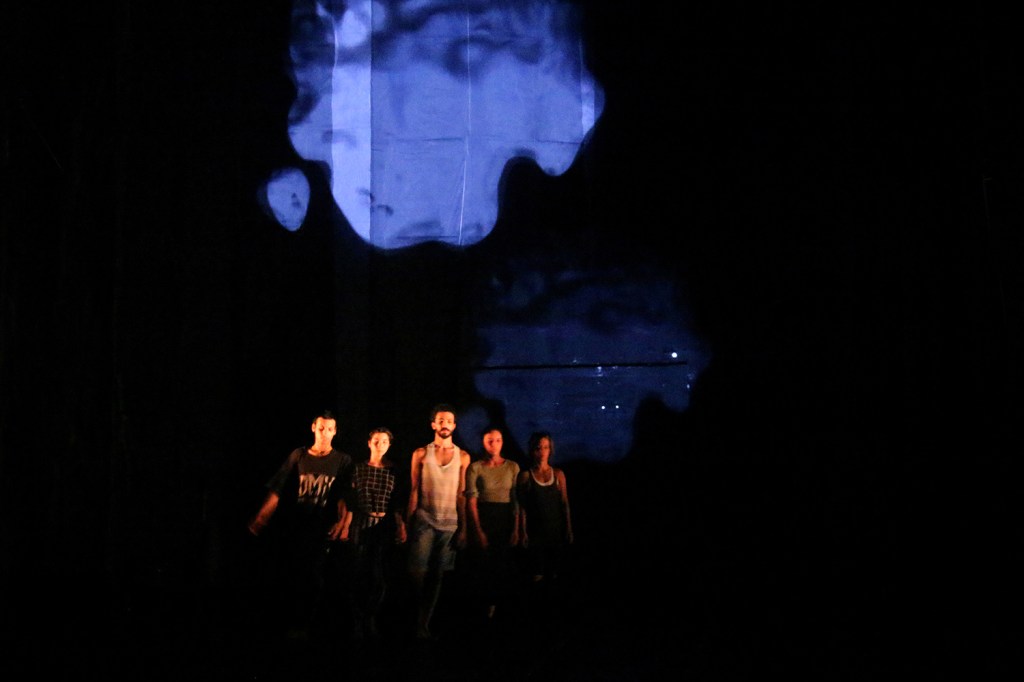
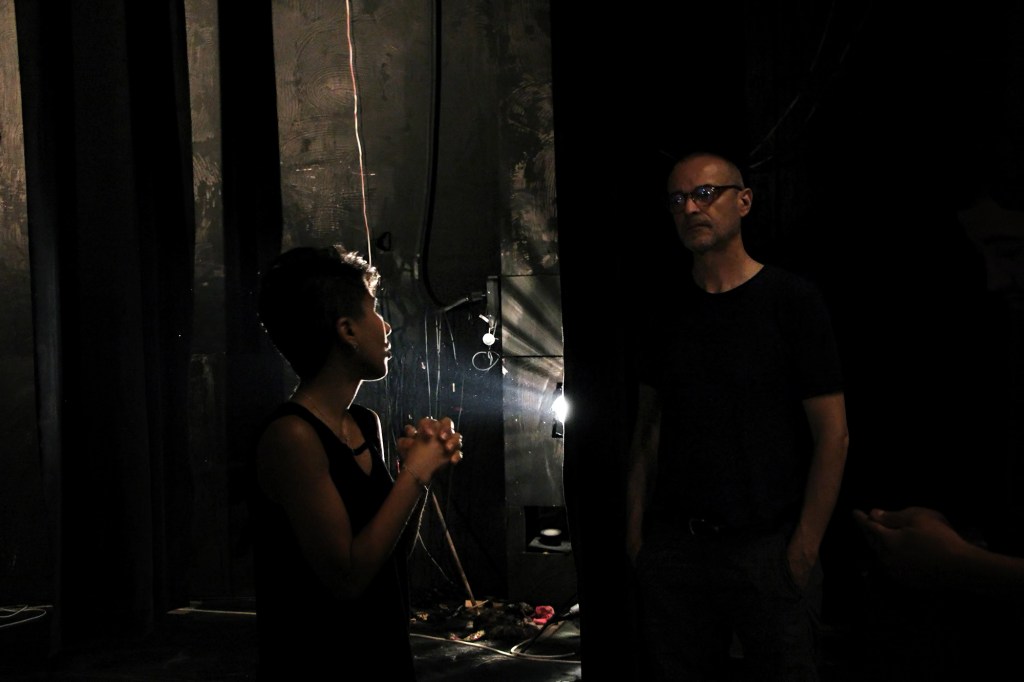
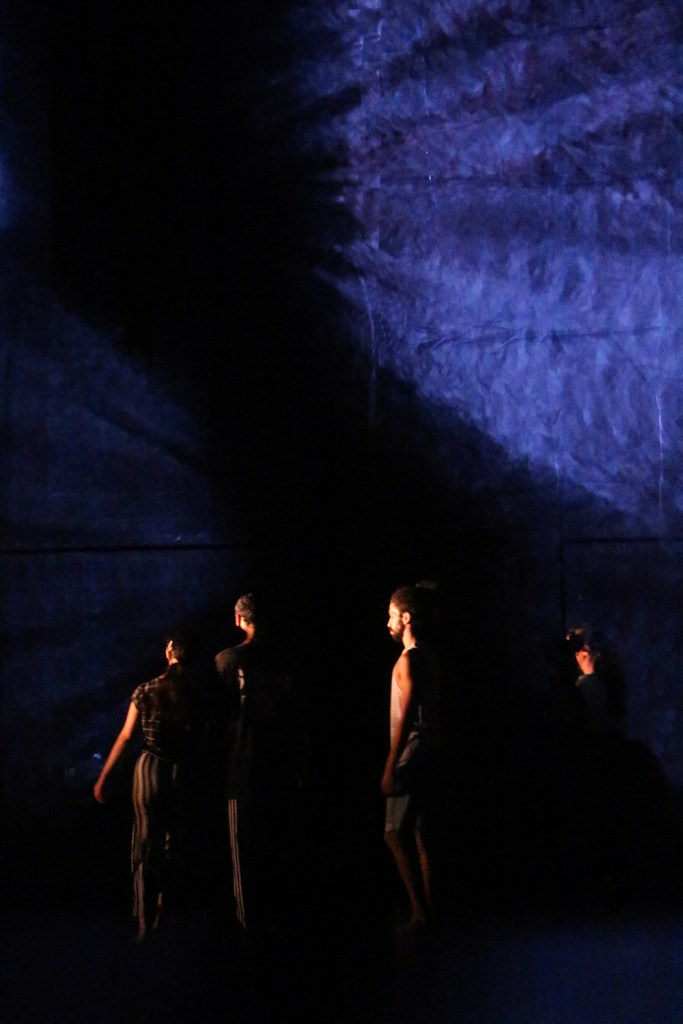
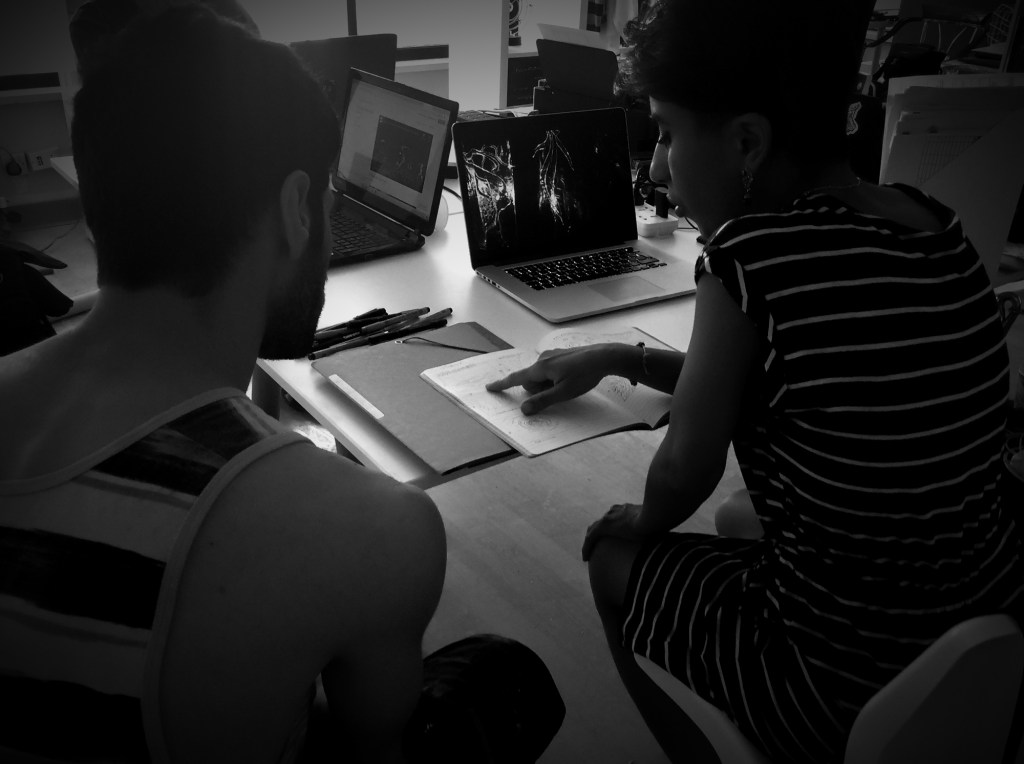
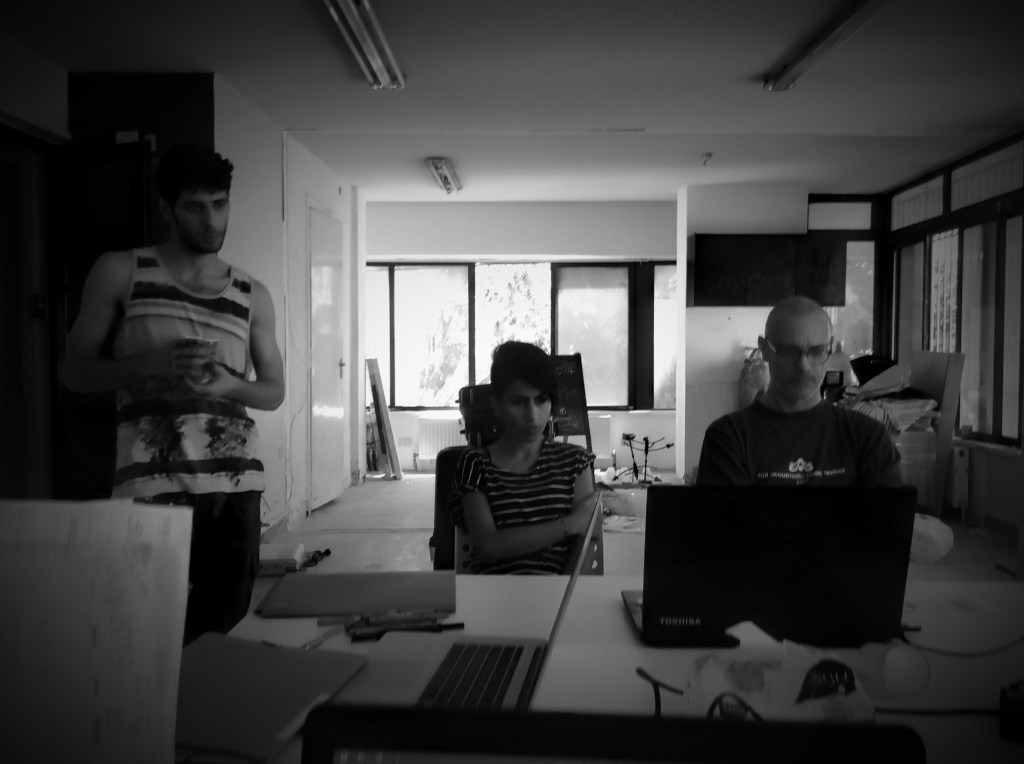
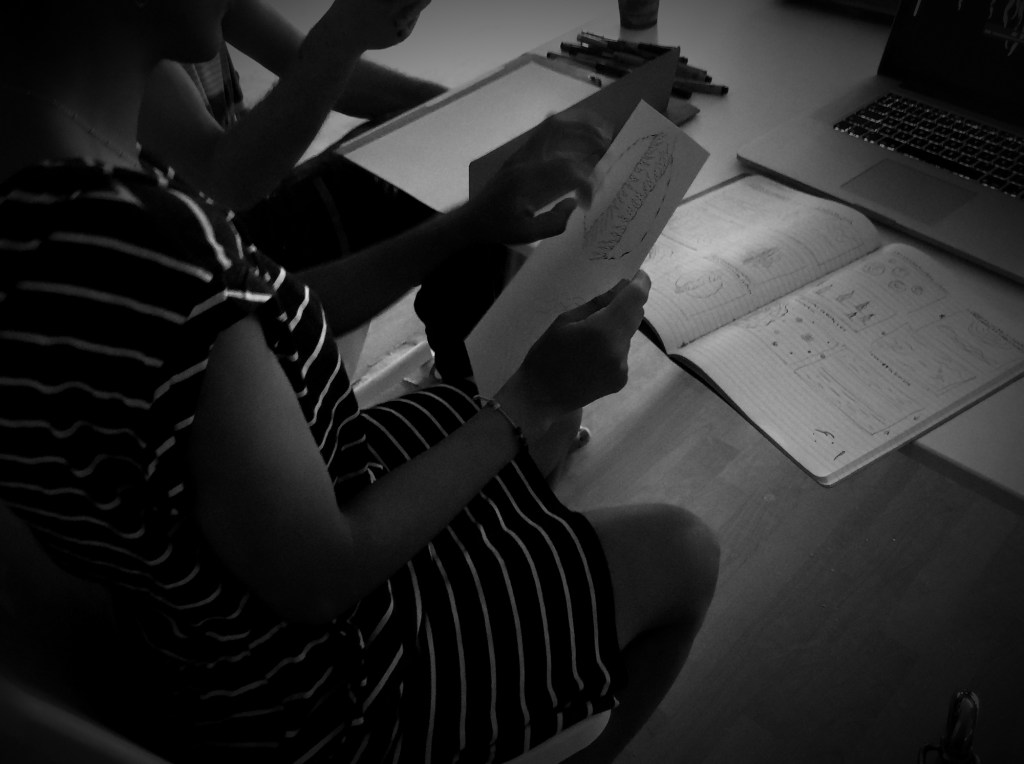
From 18 to 25 of July 2019, an interdisciplinary ensemble of artists who shared a vision to create a dance production that an interplay between a dynamic choreography and an audiovisual immersive environment is presented simultaneously, took a 5-day-residency in Amman, Jordan between dance studio, hotel rooms and theatre. The dance production will be presented to audience in Jordan on August, 2019.
Location: Studio 8, Amman, Jordan
Artist: Sound Artist François Donato, Visual artist Golnaz Behrouznia, Dance Artist Abd Al Hadi Abunahleh, Dance Artist Anas Nahleh, Visual Artist Ren
Date: 7/18/2019
Duration: 120 minutes
Part 1: Watching rehearsal videos together
I like the choreography. I like its simplicity. I wonder whether we can restructure it.
Golnaz Behrouznia
There are a lot of singularity in the choreography. What we have thought about creating contrast. We could accelerate or intensify. We though about explore the element of time. We could create fraction of time, distortion of time.
François Donato
Part 2: Brainstorming together
I noticed that the background music chosen for the rehearsal is very mechanic. Would it be a good idea to add something organic, something unexpected, something with a completely different energy? Have you thought about a-surprise-sound?
François Donato
The rehearsal you have seen is the 1st layer we have designed so far. More layers will be added through out the time.
Abd Al Hadi Abunahleh
Part 3: Going through performance storyboard together
I imagine a black background with abstract white animations.
Golnaz Behrouznia
I imagine a series of animations, each lasts 30 seconds to a minute.
Golnaz Behrouznia
How do you image the light on the stage?
Abd Al Hadi Abunahleh
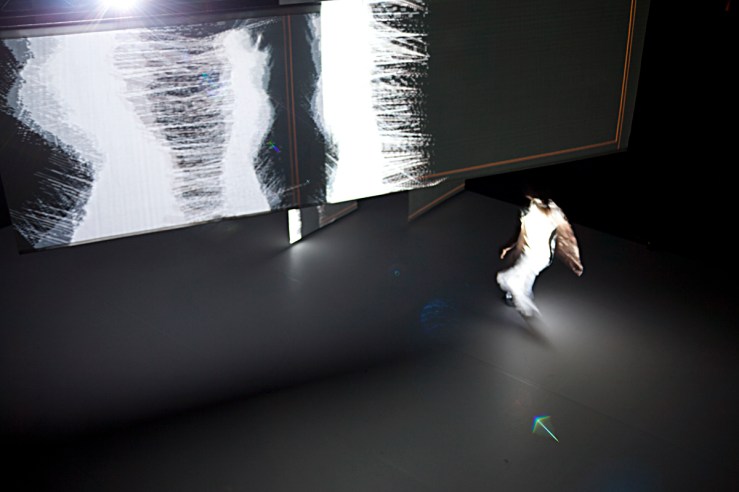
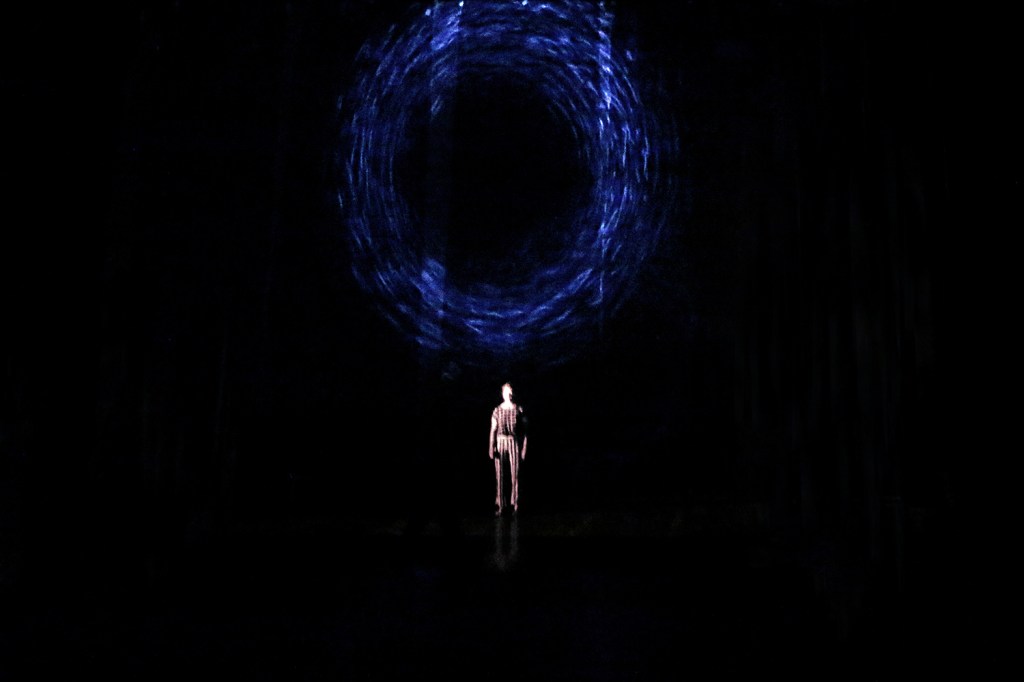
There will be a projector. There will be a moment of darkness, perhaps silence. There will be a moment of bright light on the performers. There might a moment of stillness, just the sound flowing. There might be a moment of when human presence disappears, only digital arts remain…
Golnaz Behrouznia
Bear in mind that my visual animations only make sense when with sound.
Golnaz Behrouznia
Part 4: What is next?
At the stage, let’s not focus on aligning dance, sound, visual art. Let’s experiment and explore on our own and meet again soon.
François Donato
I can imagine myself being inspired by sound and visual art. I look forward to our next meeting, our experiment of experiencing a sudden sound while dancing in our next rehearsal.
Abd Al Hadi Abunahleh
What do think of the costume?
François Donato
I imagine costume either in black or white.
Abd Al Hadi Abunahleh
We are designing an experience for the performers and the audiences.
I am really delighted to start a new experience in this part of the world that I want so much to discover , Jordan , with François Donato and as part of a new artistic collaboration with Studio 8. Studio 8 (which is) dedicated to dance practices in Amman, with a very motivated team to expand its artistic experiences, invited us to develop with them the universe of their new piece “Time out of Time”. First residency in Amman Jordan July 18-25 .
Golnaz Behrouznia turned very early to the visual arts. The direction of her artistic work is guided for a long time by the major interest which she carries in the natural sciences, in the observation of the alive and its diverse dimensions.
Further to her studies in the Fine arts of Tehran she pursues her work of visual artist in Iran and participates in several collective and individual exhibitions in particular in the Saba Museum in Tehran in 2007, and several times between 2005 and 2008 in the art center The House of the Artists in Tehran. She won several prizes during biennial events and festivals as the third prize of the Iranian Academy of the Arts, during the 5th Biennial of the Sculpture, in Tehran.
In 2008, she came in France to develop her work in the digital arts field in Toulouse. Since 2010, she presented several works and hybrid creations, between sculpture and multimedia creation as the scenography Labo Organika, at the gallery of the National School of civil aviation ENAC, to Toulouse in 2012, at the contemporary art museum Les Abattoirs, within the framework of the digital Forum of the Festival Novela, in Toulouse in 2011, as well as in the collective exhibition Vita Nova, Vivant festival, Gallery Claude Samuel, in Paris in 2015.
Her video installations were presented during the exhibition Are We Already Gone? Artists one the Art of Leaving, FlickerLab, New York 2014, in International meetings Arts and systems, in the art center Ciam-La Fabrique, in Toulouse in 2012.
In 2015 she created the interactive multimedia installation Lumina Fiction1 in association with the sound artist François Donato, with Xavier Malbreil’s curating, thanks to a grant of creation of Dicréam / CNC. This work was presented at the collective exhibition Hemispheres / Biennial of the Digital arts, Enghien les Bains in 2016 by Philippe Baudelot Currating, as well as in the International event of the digital arts, Abidjan, Ivory coast in 2017.
In 2017 she has created the interactive multimedia installation Lumina Fiction *2 with François Donato within the framework of a grant and support to creation of Clermont-Ferrand Communauté 2017. The work was presented within the framework of the Festival of digital art Vidéoformes in Clermont-Ferrand in 2017, in the Festival Tadaex, in the gallery Mohsen in Tehran in 2017, in Quai des Savoirs by the curating of Nomade Art center in Toulouse in 2017, and by Gabriel Soucheyres’s curating to the festival of digital art ADAF in Athens, Greece in 2017.
Her multimedia performance ElectroAnima-Experiment with the artist François Donato, was presented to the Festival OverTheReal in Italy, on 2017, and to the event Etat Instable, Patchwork-Emergent Arts association, in Mix Art Myris, Toulouse in 2017.
Her transmedia Scenography Vanimentis in collaboration François Donato, is presented in exhibition Label (2=3), in the art center Espace Croisé in Roubaix in 2017 and in the ElectroAlternativ Festival, to the Cultural center Bellegarde, Toulouse in 2016.
Other projects of Golnaz Behrouznia in the visual arts are in particular:
The project Imaginary of the Vegetable Seeds, in reference to the images by microscope of plant elements, 1, 2 and 3 wallpainings, in collaboration with the artist Xerou, in the emergencies of the Chiva Hospital, in Foix in 2016 and 2017.
Both series of sculptures of floating bodies in gelatins or oil, congealed or mobiles, Floating Pieces and Aquatilium:
The series Aquatilium was presented during the event to Cross the Art, the Science and the Environment, in Sfax in Tunisia in 2015. This series obtained the Individual Help to the Creation of the DRAC Midi-Pyrénées in 2014.
The series Floating Pieces were presented to the Pavillon of the Arts and the Design in the Tuileries, Paris en 2013, during a collective exhibition in the Dey gallery, in Tehran in 2008 as well as in the monographic exhibition of the artist with Aria gallery, in Tehran in 2007.
At first self-taught, he deepens his musical knowledge to the University of Pau (Master of musical pedagogy – 1989), to the Academy of Gennevilliers and to the Higher National Conservatory for Music of Lyon (electronic music composition).
He won several composition prizes, among them : Young Composers Contest in Orleans (1988), Noroit Composition Prize (1989) and Varese Composition Prize (1991). Responsible for the musical production of the Groupe de Recherches Musicales (Paris) from 1991 till 2005, he is settled in Toulouse today where he used to manage the technical coordination for the collective of composers Eole from 2005 to 2017.
From 2007 till 2012, he was a speaker at the University of Toulouse Mirail, department Plastic arts & Decorative arts on sound design and interaction design. He is now an independant artist working on several kind of Digital Arts and Musical projects, alone or in collaboration with other artists.
His works, firstly dedicated to the acousmatic music, are more and more developping in the field of Digital Arts.
He has received commissions by G.R.M., DAAD of Berlin, the French Ministry of Culture, Eole collective, Centre Culturel Bellegarde Toulouse, Teatro Massimo Palermo,Grant holder of the DAAD and the Technical University of Berlin in 1999/2000.
The concept is based on memory resurgence and aims to make sensitive the notion of springs of time. Physically, the installation is made of an array of small speakers distributed in the venue according to it’s topography and presented like sculptures. Each of them are augmented with an infrared proximeter sensor which detects the presence of a person nearby and triggers randomly some memory from a bank previously prepared with sound material recorded in the venue (voices, ambiances, noises…).
An exhibition that is about the artist’s process and is at once a scholarly retrospective, an experimental site and a laboratory.
A attempt to create an all-inclusive, top, comprehensive, first, grand, laboratory, experimental, superlative, everything type of exhibition, showing a major artwork next to a loose sketch or draft for other pieces, in retrospect, eclipses the simple, captivating beauty and impact of Eliasson’s installations.
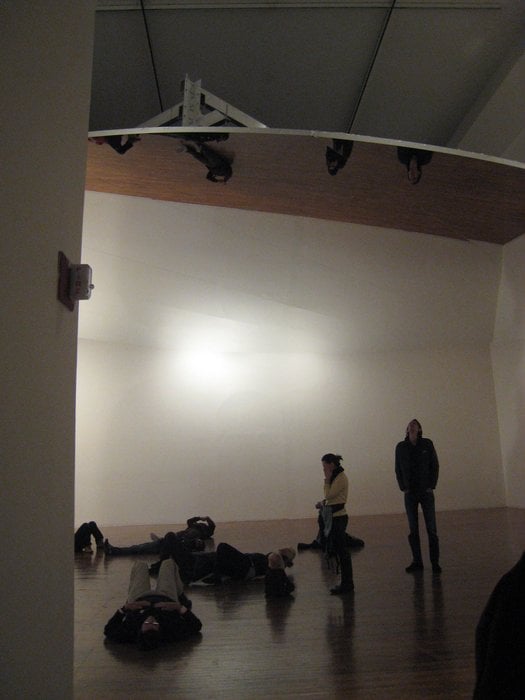
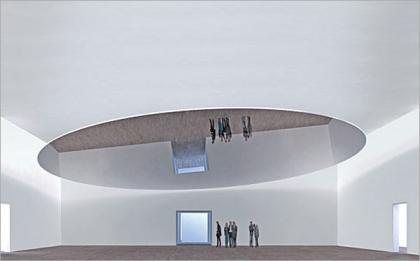
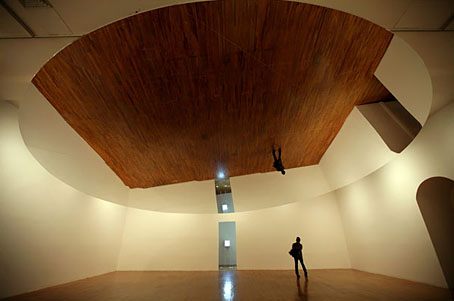
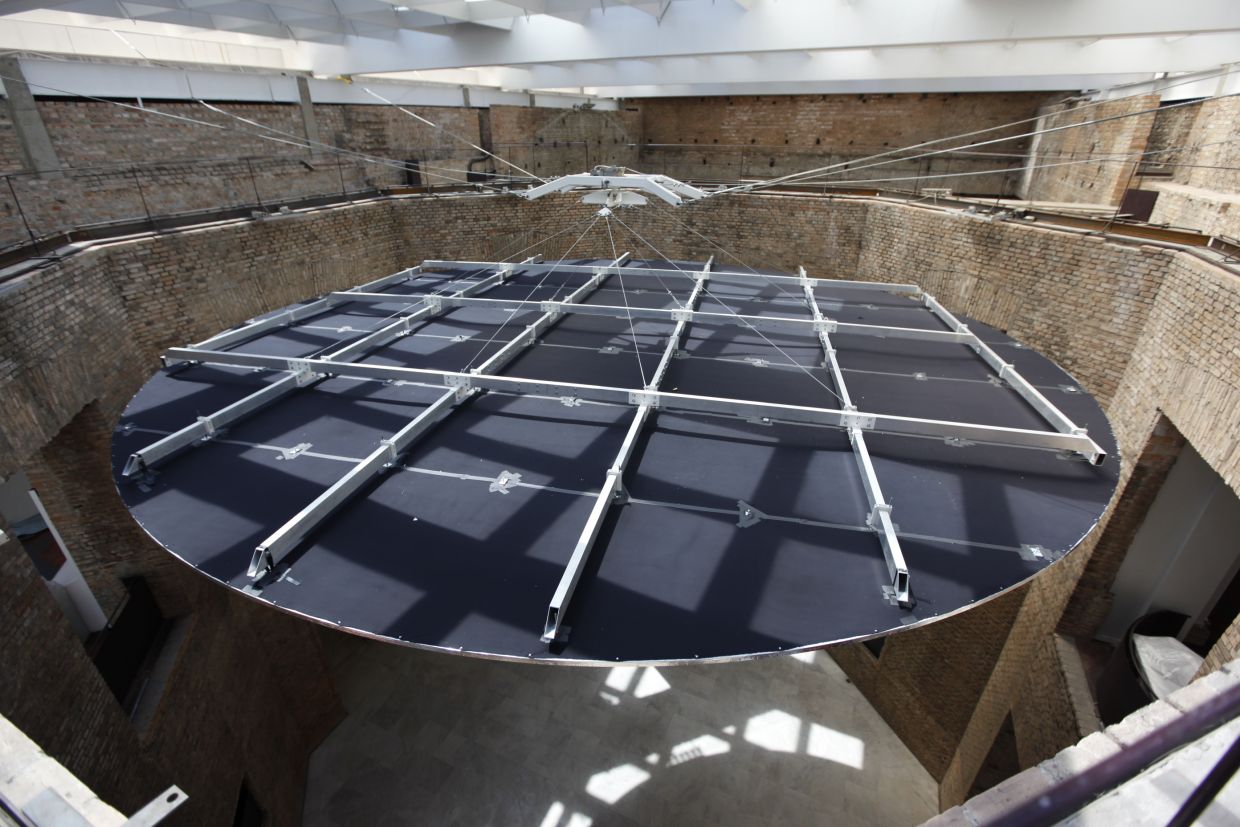
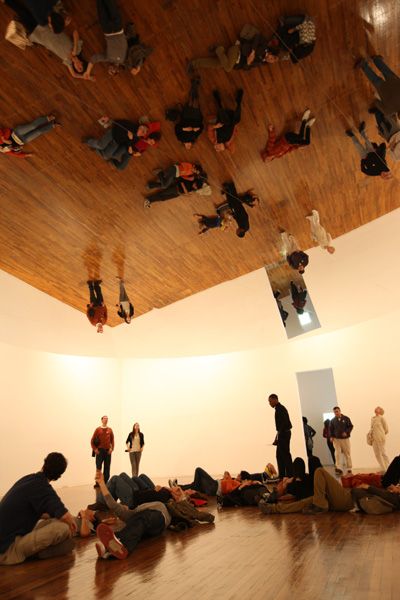
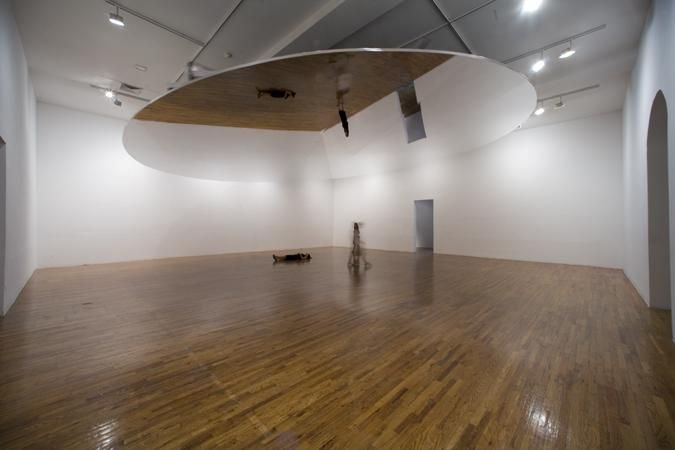
A giant, circular-shaped mirror, 40 feet in diameter and weighing 600 pounds, is mounted to the ceiling at an angle, rotating at one revolution per minute. The installation destabilizes viewers’ perception of space as they pass beneath it. Through the reflection of the gallery in the mirror, the piece actually adds light and space to the whole exhibition. Inevitably, partially also due to the weird and unpredictable layout of the rest of the exhibition, this room becomes the centre of Take Your Time. The slow motion of the ceiling piece, as well as its awkward angle that evokes the illusion that the walls bend, turn the gallery in a fascinating surreal-meditative space. Spontaneously, visitors lie down on the vast, hardwood floor and stare into the bright reflective surface of the mirror, observing how the environment distorts glacially.
Mirror foil, aluminum, steel, motor, and control unit.
How did you go about working together to build this dance hybrid installation?
A new type of collaboration.
A massive part of the whole project is just to start to have a conversation, what interests us, what kind of things might stimulate further conversation or dialogues.
….. to give us a baseline in terms of rhythm to work on top of ….
Music is very physical too. Should it be following the dance and the set? Music touches you. It could hit you, or stroke your neck.
I don’t see art as an object. I see it as a relationship, a relationship between dancers, between dancers and the stage, between dancerss and the audiences…





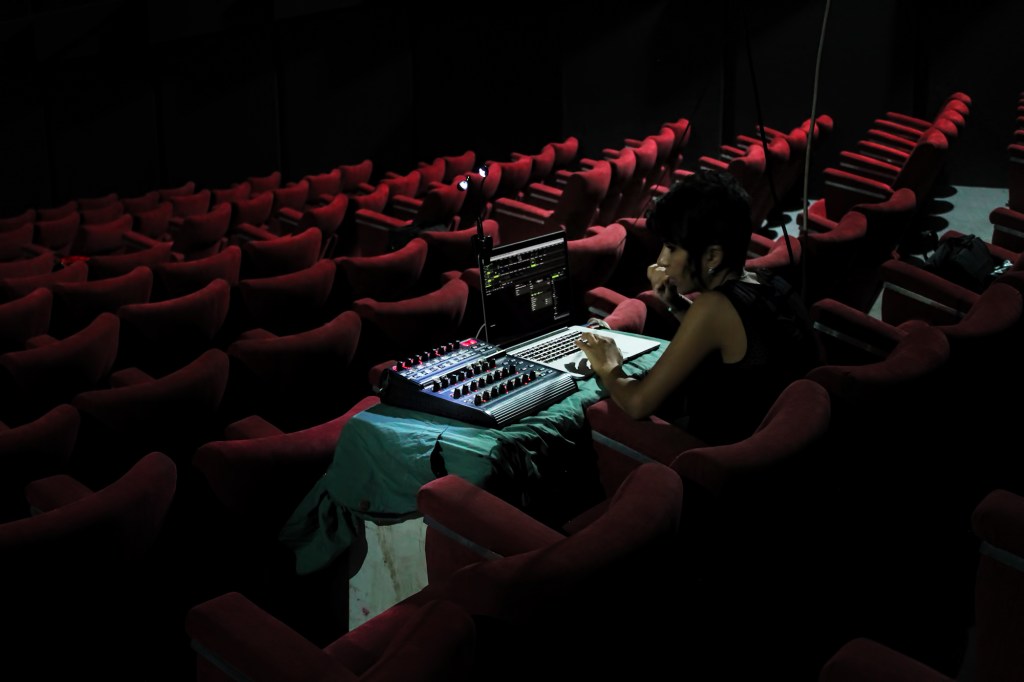
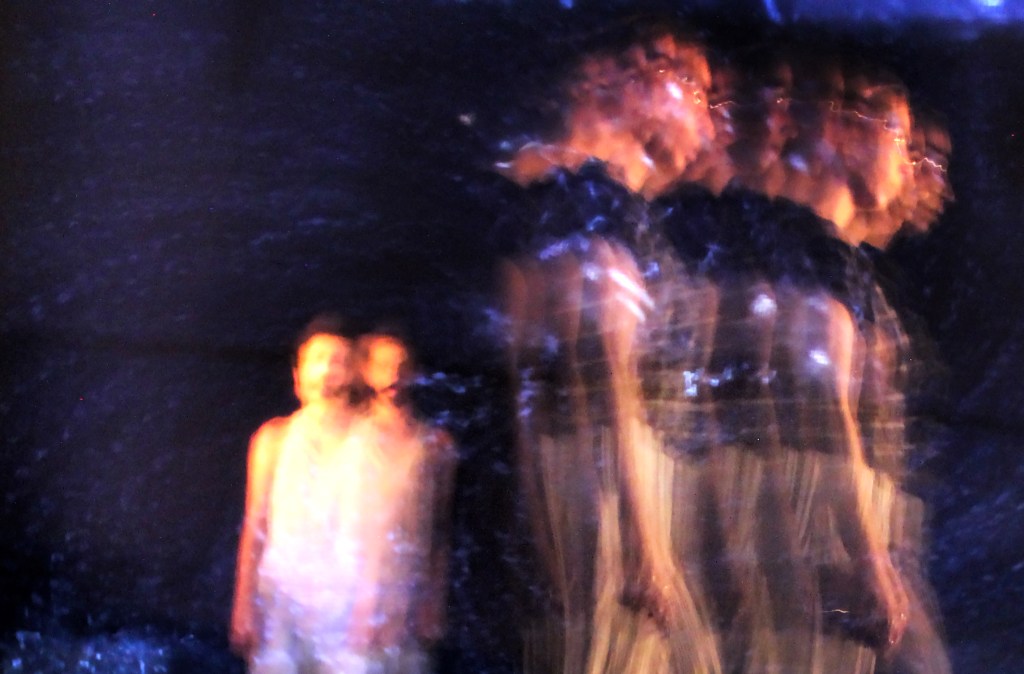
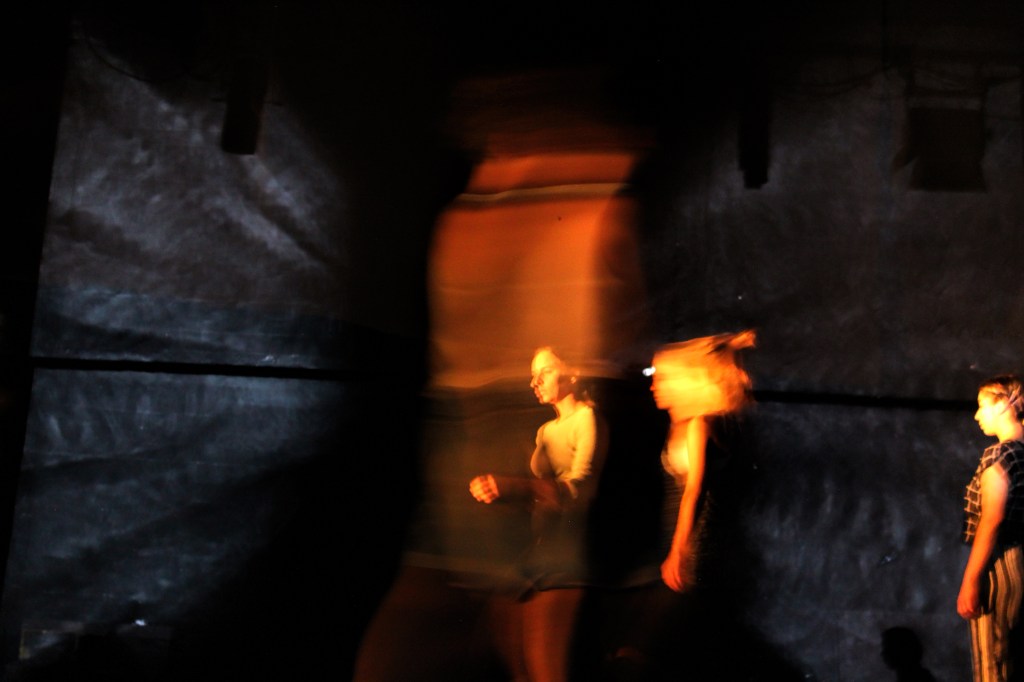
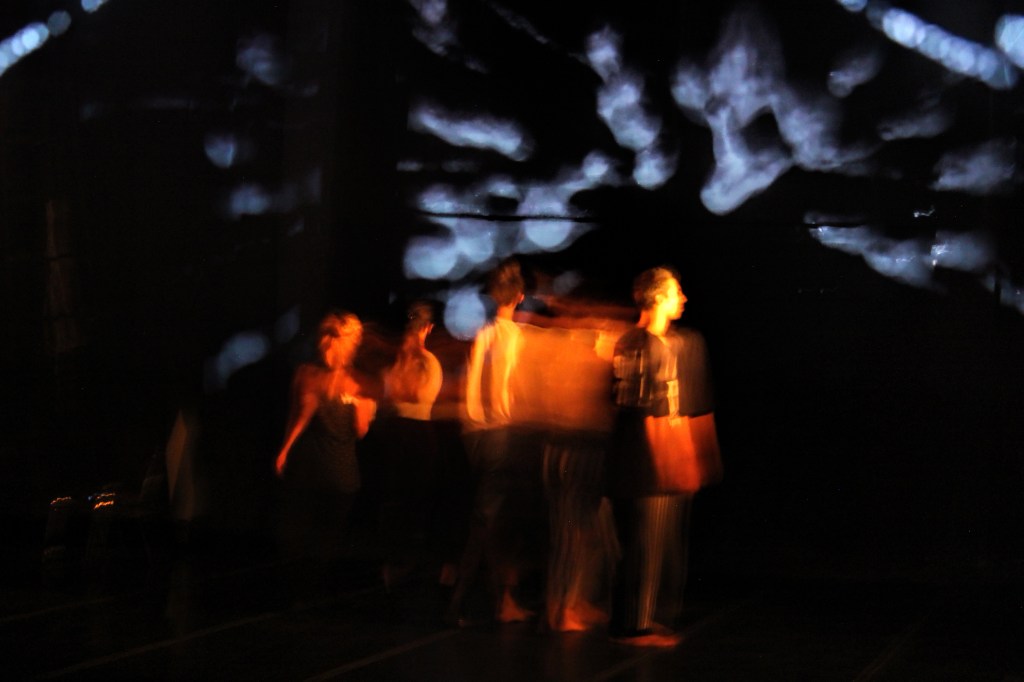






 Time out of Time: